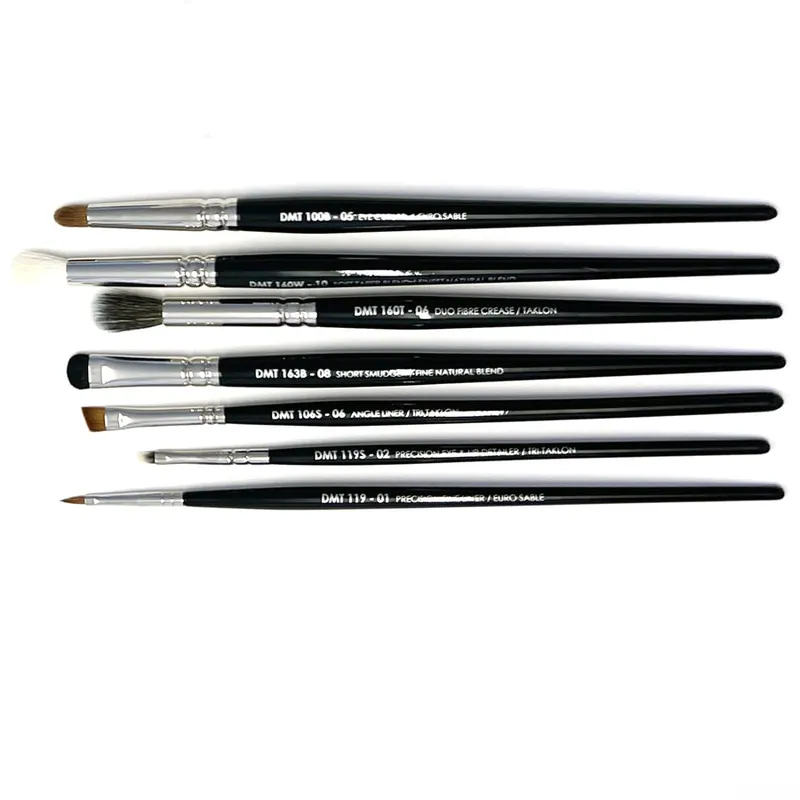
Designer Makeup Tools lists the K100-7A as a seven-brush eye-detail kit. Its appeal is a defined selection for lining, blending and small-area work, rather than a complete face collection. The purchasing question is whether those particular shapes fit your artists or customers.
A compact collection with distinct roles
The published contents identify an angled synthetic liner (106S-06), an eyeliner definer (103T-08), a crease blender (100B-05), an eye-and-lip detailer (119S-02), a tapered blender (160W-10), a larger smudging brush (163B-08) and a duo-fibre crease brush (160T-06). These are supplier-listed roles, not measured performance results. Keeping the codes in the purchasing brief makes the proposed assortment much easier to check than a generic request for seven eye brushes.
This structure makes the kit a sensible candidate for an eye-focused retail edit, a teaching kit or an artist supplement where face brushes are already available. It should not be presented as a complete foundation, powder and cheek set. Buyers seeking fewer tools should compare whether the different blending shapes add useful choices or duplicate work within their own routine.
The details that need confirmation
The listing specifically describes 106S-06 as synthetic, identifies Tri-Taklon for 119S-02 and calls 160T-06 duo-fibre. It does not establish a complete fibre specification for every brush. Do not extend one component’s material description to the entire kit. The captured record also lacks individual head dimensions, handle lengths and a clearly specified storage case; these are practical questions for a sample request.
The supplier states that an unavailable brush may be replaced with one of equal or greater value. That is significant for a set sold by its exact contents: monetary value does not guarantee the same head shape or role. Ask for advance approval of substitutions, a final component list and confirmation of how any changed brush will be described on your packaging.
How to evaluate a sample for your range
Check that each physical brush matches its listed code, then compare the distinct tasks with the cosmetic formulas your customers use. Examine the narrow liner shapes for handling and line control, and compare the three blending-oriented options on the same application task. Record observations separately for each code, including grip, head alignment and visible shedding; do not assign an unsupported overall performance score.
Request component-specific care instructions and inspect a sample after following them. Keep an approved reference and an agreed replacement policy before buying in quantity. The K100-7A is most convincing as a precisely documented eye-tool assortment. Its case for purchase becomes stronger when the material gaps and substitution rules are resolved, rather than when it is treated as an interchangeable bundle.


Community
The conversation
Be the first to share a thoughtful comment.